
Do you want to more about the Clyfford Still Museum and its namesake artist? Here are a few of our most frequently asked questions:
Q: Where is the Clyfford Still Museum?
A: The Clyfford Still Museum is in the heart of Denver’s Golden Triangle Creative District, west of the Denver Art Museum’s Hamilton Building, on the corner of 13th Avenue and Bannock St.
Q: What is in the Clyfford Still Museum?
A: The Museum offers nine galleries of Still’s art, historical photos, objects, and letters from the Clyfford Still Archives, interactive features, tranquil outdoor terraces, views into storage and conservation areas, a hands-on art creation studio, retail, and more.
Q: Who designed the Clyfford Still Museum?
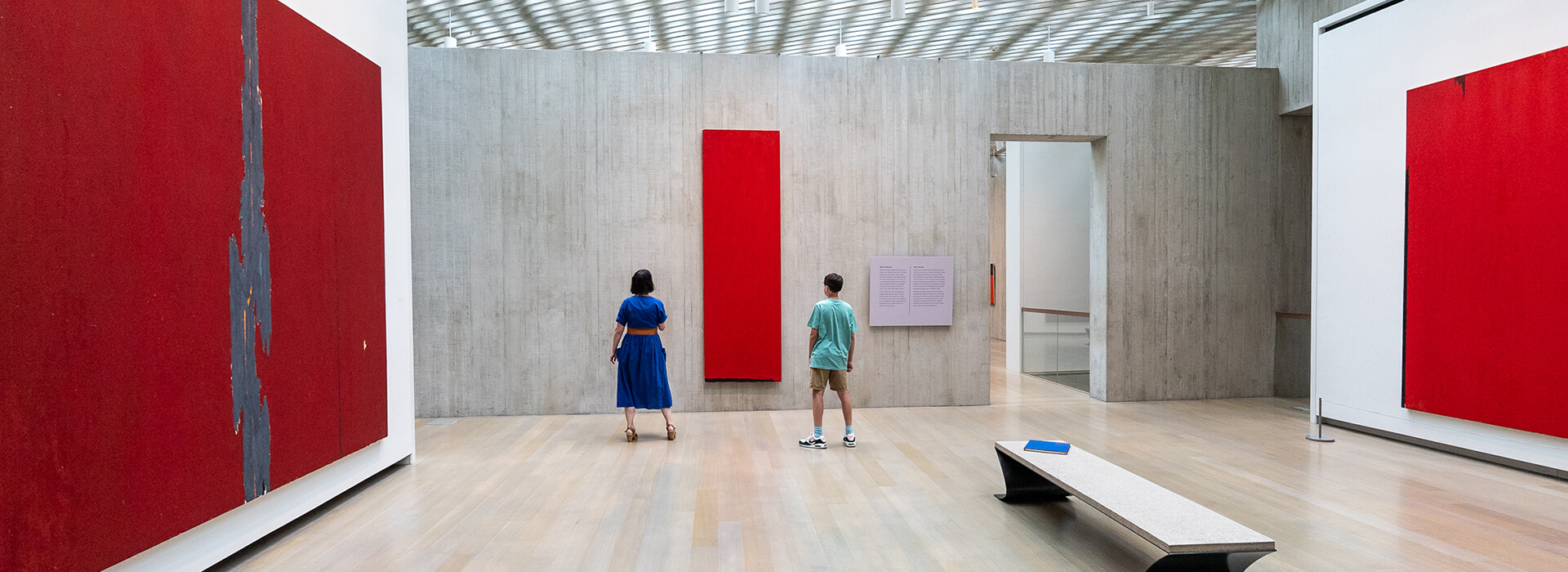
A: The two-story, 28,500-square-foot building was designed by Brad Cloepfil of Allied Works Architecture specifically to display Clyfford Still’s work. The building features a dense, cantilevered structure made of textured, cast-in-place concrete that perfectly complements the scale, themes, and colors of Still’s art.
Q: Why is the Clyfford Still Museum in Denver?
A: After he died in 1980, Still’s will stipulated that his entire collection, about 93% of everything he ever made, should go to an American city willing to establish a permanent museum dedicated exclusively to the care and display of his art. More than 20 American cities contended to receive the collection. Still’s second wife, Patricia, chose Denver as the location in 2004, and the Museum opened its doors in November 2011.
Q: Why does Clyfford Still have his own museum?
A: Clyfford Still thought the best way to experience an artist’s work was by seeing it all in one place. His overarching vision was for his work to all be seen and experienced together, as one grand life statement. He believed that all artists’ work should be viewed together.
Q: Who is Clyfford Still?
A: Clyfford Still was one of the first Abstract Expressionist artists. Abstract Expressionism is an art movement in American painting that emerged after World War II. These artists worked to develop a new approach to painting and used abstract forms, expressive paint-application techniques, and monumental scale to convey universal themes about creation, life, struggle, and death. Still’s contemporaries included Grace Hartigan, Willem de Kooning, Lee Krasner, Norman Lewis, Joan Mitchell, Robert Motherwell, Barnett Newman, Jackson Pollock, and Mark Rothko.
Q: How did Still’s style evolve?
A: Still’s work wasn’t always abstract. His earliest artworks depicted outdoor scenes, people, trains, and farm machinery. In the mid-1930s, Still began to be more interested in making art that depicted his “inner comprehension” over that which can be seen in the external world. Over time, he began to make people’s hands bigger, stretch their faces, and use more imaginative and expressive colors. As his style evolved, Still’s works transitioned to using more abstract shapes, colors, and lines to express an idea or feeling, eventually completely erasing representational forms from his work around 1942–44. As his work evolved in the 1950s, it became larger in physical scale and began to include massive expanses of color. After moving to Maryland, he experimented more with form, paint application techniques, and his color palette. He used less paint in many of his late paintings, making them feel lighter and more open.
Q: What materials did Still use?
A: His painting process involved mixing his own oil paints and primarily using palette knives to apply the paint (though he also used brushes). Still used ladders to reach all areas of the stretched canvas, painting them upright, just as visitors experience them in the galleries. He preferred to paint on unprimed cotton duck canvas, which he sized with rabbit skin glue. During the Great Depression and WWII, he painted on various other cloth materials, including window shade, linen, and dyed cloth. He also used a wide variety of media on paper over the course of his life. He used graphite, charcoal, oil pastel, chalk, wax crayons, watercolor (both opaque and transparent), pen and ink, and tempera. His paper choices were just as diverse: Strathmore artists papers, pressed watercolor paper, letterhead, sketch pads, and construction paper. He also utilized printmaking techniques, creating etchings, lithographs, woodblock prints, and one screenprint. Still even made a few sculptures in plaster, wood, and mixed-media construction. Later in life, he experimented with latex house paint on his canvases with a roller and sometimes used commercial tube paints.
Q: Why did Clyfford Still keep so much of his art?
A: His overarching vision for his work was for it all to be seen and experienced together as one grand statement. This concept began to materialize for Still very early on in his career. Because his art held such personal meaning for Still, he found it difficult to part with anything or subject it to public critique for fear of it being misunderstood or exploited. In 1951, at the very time demand for his work grew, Still ended his relationship with his art dealer and from that time forward, only a select few of his works were publicly exhibited or entered the art market. As a result, the Clyfford Still Museum is home to nearly everything he created, approximately 93% of his lifetime of work.
Q: Did Clyfford Still ever live in Denver?
A: No. While Clyfford Still never lived in Denver, he was invited to participate in the Visiting Artist Series at the University of Colorado Boulder during the summer of 1960. During this ten-week residency, Still taught advanced oil painting.
Q: How did Still make his money?
A: Still was an art teacher for most of his life, teaching art in colleges and universities across the country, even leading the painting department at California School of Fine Arts in San Francisco in the 1940s. While he retreated from the gallery system in New York, he never stopped selling his art to people he trusted.
Q: How many artworks are in the collection?
A: Approximately 3,125 pieces, including 843 paintings, more than 2,300 works on paper, and 3 carved wood and mixed media sculptures. In addition to the artworks, the Museum is home to the artist’s archives of letters, sketchbooks, manuscripts, photo albums, and personal effects.
Q: Does the Museum own the collection?
A: No. When Clyfford Still died in 1980, his will stipulated that he would give his entire collection to an American city. So, the City and County of Denver owns the collection.
Q: How does the Museum care for the collection?
A: The ongoing care of the Clyfford Still Collection is critical to the Museum. As stewards for most of the the artist’s work, the Museum’s conservation team is tasked to interpret the inevitable changes that occur in Still’s work and find the appropriate balance between adhering to the artist’s intent in terms of its aesthetic appearance and ensuring the artworks’ safety.
Q: Is the artwork behind glass?
A: We display the paintings without the protection of glass so you can see the richly varied surfaces. Works on paper are displayed behind glass for their protection. We ask visitors to help keep the paintings safe for the enjoyment of future generations by keeping a safe distance away from the artworks.
Q: Where can I learn more about the collection?
A: Visit Clyfford Still Online and our free digital guide on Bloomberg Connects (scan the QR codes in the galleries to access the mobile web guide or download the free app).
Q: What percentage of the collection is out on display right now?
A: Only a small fraction of our collection is on view during a show. We have over 3,000 works of art in our collection, and about 100 are on display at any given time.
Q: How often do you rotate exhibitions?
A: Exhibitions change every seven to nine months. Many exhibitions also rotate works on paper midway.
Q: Do you always display his works with the focus that’s currently on view?
A: We offer exhibitions on various topics. Our curatorial team is constantly working to find new ways of presenting and organizing Still’s art in our galleries, and we invite diverse external perspectives on his work through guest curation, community-led interpretation, and collaborative exhibition development.
Q: What does the PH in the title of Still’s paintings refer to?
A: Still specifically did not title his artwork, as he did not want viewers to have any sort of pre-determined associations. Instead, an alphanumeric system is used to identify each artwork. PH stands for Photo, and the number refers to the order in which the artworks were photographed (not made). Other abbreviations include PP (Photo of Pastel), PD (Photo of Drawing), PL (Photo of Lithograph), etc. He did not assign titles to his artworks because he wanted people to make their own interpretations of what they see, think, or feel when looking at his work.
Q: What does the yellow rectangular piece of vinyl next to the PH-number mean?
A: The small rectangular piece of vinyl next to the PH-number indicates that the artwork is on view for the first time. Many works in the collection have not been on view previously.
Q: How long should I plan for my visit?
A: Most visitors spend around an hour in the Clyfford Still Museum, but times vary.